Ucraina


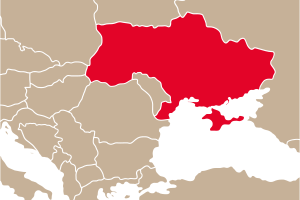
Ukraine was the earliest of the East Slavic states, and Kievan Rus’ represented the first cultural and institutional centre of the Russo-Slavic world. Weakened by internal struggles and Mongol invasions, Kyiv was later annexed by the Polish–Lithuanian Commonwealth. From the cultural and religious legacy of Kievan Rus’ emerged both the Russian Empire and, in the twentieth century, Ukrainian nationalism. During the second half of the eighteenth century, the Russian Empire absorbed most of the Ukrainian territory that had remained under Polish and Ottoman rule. Following the collapse of Tsarist Russia in 1917, several independent governments briefly emerged in Ukraine (1917–1920); however, at the end of the Russian Civil War, the region was conquered by the Bolsheviks and became a Soviet republic.
In the 1930s, the so-called “breadbasket of Europe” suffered a severe famine, the Holodomor, in which approximately six million people died. This catastrophe was caused by Stalin’s collectivization policies. During the Second World War, German and Soviet forces were responsible for a further seven to eight million deaths. In 1986, an accident at the Ukrainian nuclear power plant in Chernobyl produced the worst nuclear disaster in history.
In 1991, following the collapse of the Soviet Union, Ukraine achieved independence through a referendum approved by an overwhelming majority. Nevertheless, democracy and prosperity remained unfinished goals, due to the legacy of Soviet bureaucracy, the rise of oligarchic structures, and endemic corruption, which hindered efforts toward economic reform, privatization, and the protection of civil liberties. In 2004 and 2005, a mass protest in Kyiv, known as the “Orange Revolution,” forced the authorities to overturn the presidential election results and allow a new vote, which brought the reformist economist Viktor Yushchenko to power. The pro-Russian politician Viktor Yanukovych became prime minister in 2006 and was later elected president in 2010. In 2012, Ukraine held parliamentary elections that Western observers considered compromised by electoral fraud.
In 2013, Yanukovych suspended a cooperation agreement with the European Union in favour of closer economic ties with Russia. Protests erupted in Kyiv, leading to a three-month occupation of the central Maidan square by demonstrators. In 2014, the use of violence by security forces to disperse the protests caused numerous casualties and provoked international condemnation. The crisis resulted in the president’s sudden flight to Russia and the appointment of the pro-Western leader Petro Poroshenko. The current president, Volodymyr Zelensky, defeated him in the 2019 runoff election with 73% of the vote.
In 2014, Russian President Vladimir Putin ordered the invasion of the Ukrainian peninsula of Crimea, which a United Nations resolution reaffirmed as being under Ukrainian sovereignty. In mid-2014, Russia instigated a civil war in two eastern Ukrainian provinces, in the Donbas region. International efforts to end the conflict failed, and between 2014 and 2022 more than 14,000 soldiers and civilians were killed or injured. On 24 February 2022, Russia launched a full-scale invasion of Ukraine, triggering the largest conventional war in Europe since the Second World War. Despite substantial advances by Russian forces during the initial weeks of the assault, the unexpected resistance and combat capability of Ukrainian forces prevented Russia from achieving its objectives. The invasion also generated the largest refugee crisis in Europe since the Second World War, with over six million Ukrainian refugees. President Zelensky, leading his country’s resistance with the aim of preserving Ukraine’s independence and territorial integrity, has called for Ukraine’s accession to NATO and has submitted an application for membership in the European Union.
The agreement, signed at Med-Or’s headquarters in Rome, aims to strengthen cooperation in diplomatic training and international dialogue, including through the development of joint initiatives and new opportunities for collaboration between Italy and Ukraine
| Head of state | Volodymyr Aleksandrovych Zelensky |
| Head of Government | Yulia Anatolievna Svyrydenko |
| Institutional Form | Semi-presidential Republic |
| Capital | Kiev |
| Legislative Power | Verkhovna Rada or Ukrainian Parliament (450 seats) |
| Judicial Power | Constitutional Court (composed of 18 judges) |
| Ambassador to Italy | Yaroslav Melnyk |
| Total Area kmq | 603,628 square kilometres (km²) |
| Weather | Harsh continental climate, except for the Black Sea region, which is mild and temperate; winters are cold and humid; summers are hot and dry. |
| Natural resources | Iron ore, coal, manganese, and titanium, as well as some deposits of uranium, lithium, and other critical minerals. In addition, Ukraine has significant natural gas reserves and so-called “black soils,” which make it a major agricultural producer. |
| Economic summary | Ukraine is one of the world’s largest grain exporters, particularly of corn, sunflower seeds, wheat, soybeans, and barley, as well as metals and chemical products. The average salary in 2021 (before the war) was $525. Half of the country’s electricity is generated from nuclear power. In 2022, the economy contracted by 35% as a result of the Russian invasion. |
| GDP | $205.742 billion (2025 estimate) |
| Pro-capite GDP (Purchasing power parity) | $6,261 (2025 estimate) |
| Exports | $41.73 billion (2024) |
| Export partner | China, India, Turkey, Poland, Italy, and Germany (2024) |
| Imports | $70.7 billion (2024) |
| Import partner | China, Poland, Germany, Turkey, and the USA (2024) |
| Trade With Italy | Italy is Ukraine’s 7th largest export market, with a trade volume of $2.13 billion (2024) |
| Population | 32,862,000 (2025) |
| Population Growth | 1.26 births per woman (2022) |
| Ethnicities | Ukrainians make up approximately 77.8% of the population. Russians are the largest minority, at around 17.3%. Other ethnic groups, including Belarusians, Moldovans, Tatars, Bulgarians, Hungarians, Romanians, and Poles, each account for less than 1% |
| Languages | The official language is Ukrainian, although the Constitution protects Russian for historical reasons. The population is largely bilingual, with Ukrainian widely spoken in western Ukraine (the former Austro-Hungarian Galicia), while Russian remains commonly used in southern Ukraine. |
| Religions | he Ukrainian population is predominantly Christian, with 72% identifying as Orthodox. However, the Orthodox community is divided into two main branches: the Ukrainian Autocephalous Orthodox Church and the Ukrainian Orthodox Church, which is dependent on the Moscow Patriarchate (the latter was the majority before the Russian invasion but has since declined significantly). Ukrainian Greek Catholics account for 8–10%, Protestants 2%, and Roman Catholics 1%. Muslims and Jews each constitute less than 1% of the population. |
| Urbanization | 70% |
| Literacy | 100% |
